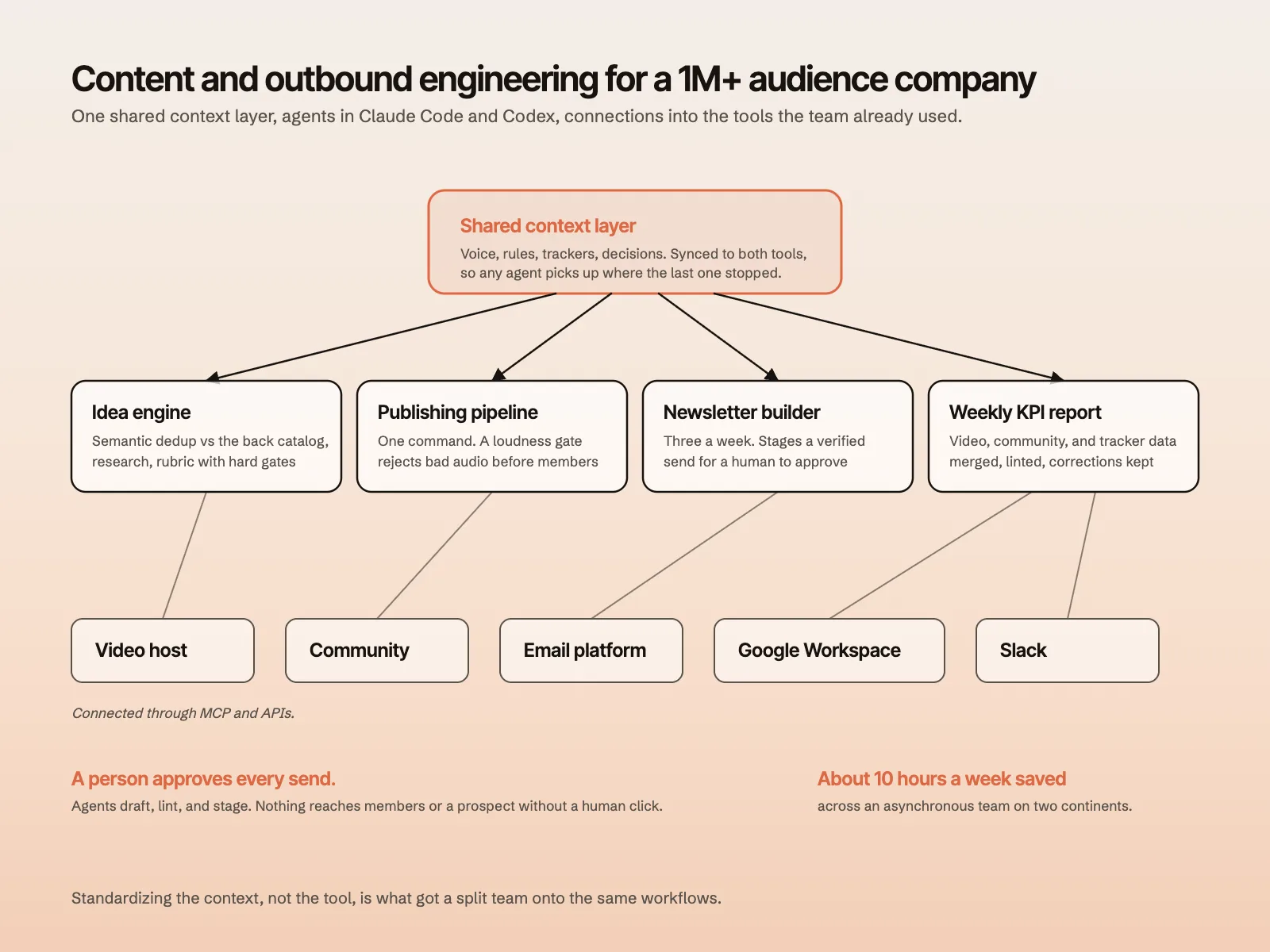
- Architecture
- A shared context layer (voice, rules, trackers, decisions) synced to both Claude Code and Codex, so any agent picks up where the last one stopped. Skills for each job: video ideas, post-video, newsletter build and publish, KPI report, lead enrich, lead check, email capacity. MCP and API connections into Wistia, Circle, the email platform, Google Workspace, and Slack.
- Where it runs
- On the educators' machines, with a person pressing start. Sending ran on Smartlead over Microsoft mailboxes; sourcing on Apify and free registries; the KPI report published to a stable link.
- Tests and evals
- A rule gate on every cold email (no years, no street names, no clinical language, no 'AI', sign-off matches the inbox), run as a script before any batch. A lint on the KPI report before publish, with a corrections trail when a number was wrong. Every capacity number came from the script, never from memory.
- Cost and latency
- About $1 per 30 researched leads. The content pipeline ran on existing subscriptions.
- Guardrails
- A human approves every send: newsletters stage a verified test, campaigns stay drafts until a person activates them. Capacity rules (2 emails per inbox, 100 per domain per day, 14-day warm-up) enforced in code. The whole outbound system was wound down in 2 days with a full export and a restart guide.
- The tradeoff we chose
Why this way and not the other
The opinion question beat the direct pitch in every A/B pair, so we stopped pitching. And when the numbers said cold email was not the channel for this buyer, we reported that instead of optimizing the copy again. The system's job was to make that finding checkable.
- Code
- The live proof pages (offer chains, ICP decision, KPI report, savings calculator) are still up on Vercel; links on request.