All builds Book a call
Stephens AI · our own tooling · Stephens AI · v2 live 2026-03-01

The AI operating system my own company runs on: 9 agents, 51 skills, 15 connected services.

I test everything on myself first. The same architecture I install for clients runs my own practice.

9agents each on a least-privilege tool list, plus 51 reusable skills and 15 connected services
07:30 every morning: new meeting recordings become pages, priorities, decisions, and a text with the action items
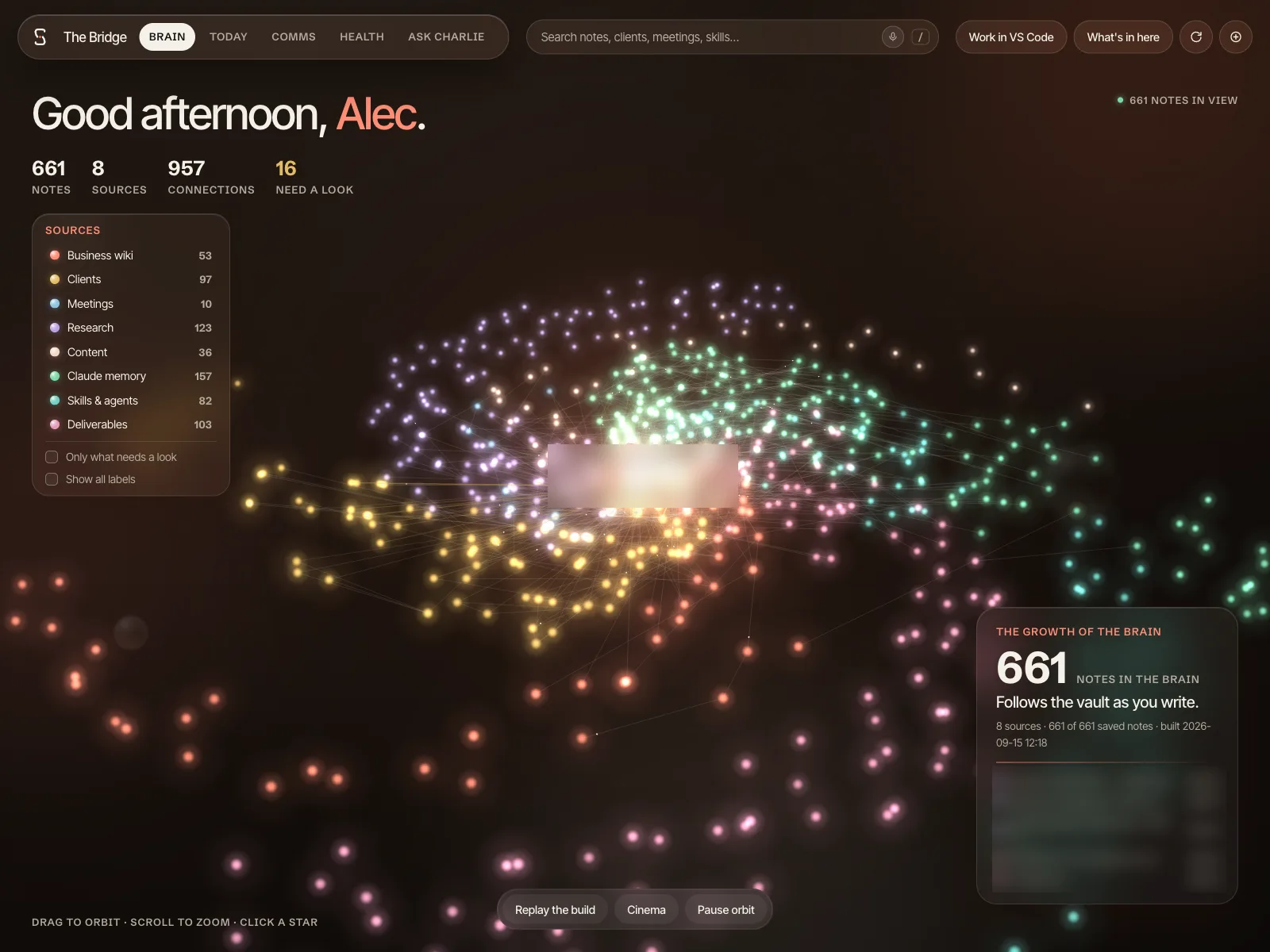
The Bridge dashboard: a 3D graph of the vault beside today's calendar and inbox
The Bridge, the dashboard over the whole company. Two panels blurred.
What was broken

Before

A consultancy of two generates the same admin any client does: meeting notes, priorities, research, proposals, follow-ups, and a vault of context that goes stale the moment nobody reads it.

What I built

The build

What changed

Before and after

Before

By hand
After a client callNotes typed up later, or not
Finding a factGrep and memory
A repeated jobRe-explained each time
Sending anythingWhatever the model decided

After

The system
After a client callPage, priorities, decisions, text by 07:30
Finding a factRetrieval search over the vault
A repeated jobA skill with the gotchas encoded
Sending anythingA human approval step, always
Where the numbers come from. Counts are from the system's own registry on 2026-09-10. They change weekly.
For engineers

How it's built

Architecture
A markdown vault with frontmatter as the database, a generator that rebuilds the index, sub-agents defined as files with tool allow-lists, skills as files with the gotchas at the top, a local dashboard server, and scheduled jobs on the Mac that deliver to iMessage.
Where it runs
On my Mac, with connectors into Google Workspace, Slack, Fathom, and the clients' tools.
Tests and evals
A weekly lint over the vault (contradictions, stale facts, orphans), a layout lint on every branded page, and a two-reviewer gate (adversarial fact-check plus a domain reviewer) before anything client-facing ships.
Cost and latency
One subscription plus about $10 a month of API credits.
Guardrails
Every agent runs on a least-privilege allow-list. Nothing is sent, deleted, or deployed without a fresh yes. Every scheduled job leaves a trace.
The tradeoff we chose
Why this way and not the other

Files over a database. A vault of markdown is slower to query than Postgres, but every agent, every human, and every future rebuild can read it, and the whole thing is in git.

Keep going